

Global demand for medical aesthetic procedures continues to grow. ISAPS reported that nearly 38 million surgical and nonsurgical procedures were performed by plastic surgeons in 2024, representing a 42.5% increase over four years.
Botulinum toxin and hyaluronic acid fillers remained the two most widely performed nonsurgical procedures. Alongside them, collagen-based and regenerative injectables offer different mechanisms, treatment timelines, and product profiles.
Against this expanding market background, this article compares hyaluronic acid, collagen, regenerative materials, and botulinum toxin by subtype, application, benefits, limitations, regulatory position, competitive landscape, and market status.
Four Major Injectable Material Categories at a Glance
Common injectable aesthetic materials mainly fall into four categories: hyaluronic acid, collagen, regenerative materials, and botulinum toxin.
• Hyaluronic acid fillers provide immediate volume and contour correction through a configurable gel structure.
• Collagen injectables provide direct protein-based support, with product performance influenced by collagen source and formulation.
• Regenerative materials stimulate collagen formation and/or provide a longer-term scaffold, so their effects are generally more gradual and material-dependent.
• Botulinum toxin temporarily reduces targeted muscle activity. It is a neuromodulator rather than a filler and does not replace lost tissue volume.
In terms of current market applications, HA fillers and botulinum toxin have the most established clinical use, while some collagen and regenerative products are designed for more gradual or longer-lasting outcomes. Newer injectable ingredients are also entering the market.
CATEGORY | CORE MECHANISM | COMMON APPLICATIONS | ONSET / TYPICAL DURATION | U.S. FDA CLASSIFICATION | CHINA NMPA CLASSIFICATION |
HA Filler | Cross-linked gel restores volume and supports contour | Facial folds; lip, cheek, and chin augmentation; selected scars | Immediate; approximately 6-12 months, depending on product and treatment area | Class III medical device; PMA pathway for approved aesthetic dermal implants | Class III medical device when used for injectable tissue-volume augmentation |
Collagen | Protein matrix provides direct soft-tissue support | Fine lines, wrinkles, selected scars, and contour deficiencies | Usually immediate; temporary and product-dependent | Class III/PMA when approved as an aesthetic dermal implant; availability is product-specific | Class III medical device when registered as a collagen implant or injectable filler |
Regenerative Materials (PLLA, CaHA, PCL, PMMA) | Stimulate collagen formation and/or provide a biodegradable or persistent scaffold | Volume restoration, facial folds, contouring, and selected tissue-quality applications | Gradual or immediate plus gradual; material- and product-dependent | Class III/PMA for approved CaHA, PLLA, and PMMA fillers; PCL is not listed in FDA’s current overview | Product-specific; injectable PLLA filler is explicitly listed as a Class III device |
Botulinum Toxin | Temporarily inhibits acetylcholine release and reduces targeted muscle activity | Dynamic glabellar, forehead, and lateral canthal lines | Develops over several days; commonly lasts three to five months | Prescription biological product; BLA pathway; not a medical device | Regulated as a drug; injectable type A is subject to medical toxic drug controls |
Note: Regulatory classifications are product- and market-specific and may vary by formulation, indication, and jurisdiction. Buyers should independently verify local registration status, approved labeling, and intended use before procurement or distribution. | |||||
Explore more: 2026 Regulatory Map for Injectable Dermal Fillers: US, EU, China, South Korea, Brazil
Hyaluronic Acid Dermal Filler
Hyaluronic acid remains one of the most frequently used injectable filler materials worldwide. Approximately 6.3 million hyaluronic acid filler procedures were performed by plastic surgeons in 2024, a 5.2% year-on-year increase.
In filler formulations, cross-linking creates a more stable gel network, while particle size, rheology, and intended tissue plane differentiate products for different correction depths. Product-labeled applications commonly include facial folds and augmentation of the lips, cheeks, and chin.
Explore more: Hyaluronic Acid vs. Sodium Hyaluronate vs. Cross-linked Sodium Hyaluronate
Key Benefits of Hyaluronic Acid
• Immediate volume and contour correction
• Options for different tissue planes
• High safety profile with good tissue biocompatibility
• Longer-lasting results with a naturally absorbable material profile
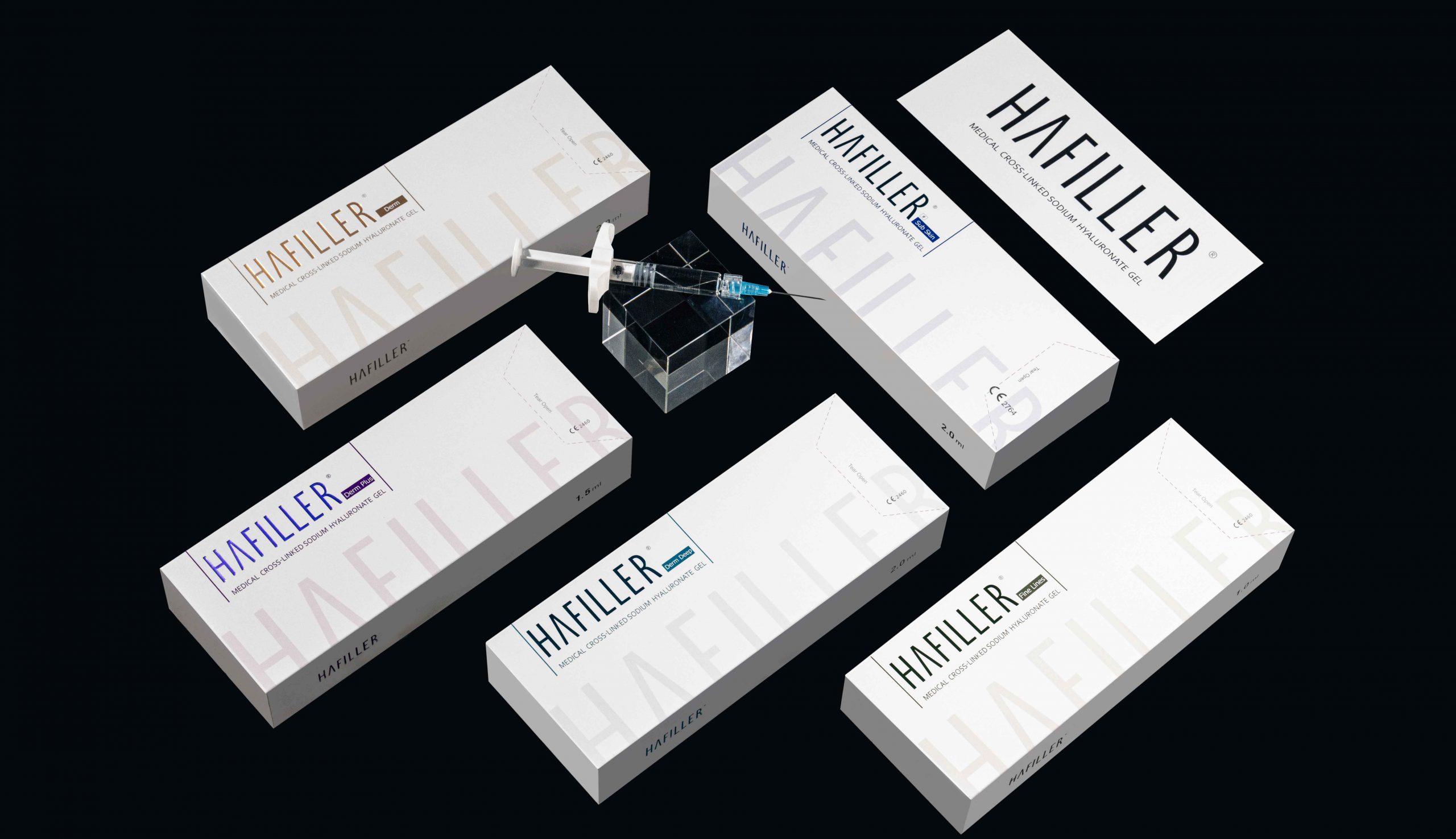
Jingjia Medical’s HAFILLER Portfolio
These characteristics support portfolio-based supply across different treatment depths and correction goals. At Jingjia Medical, we offer five 20 mg/mL cross-linked sodium hyaluronate formulations under HAFILLER, differentiated by particle size, recommended tissue layer, needle specification, and company-stated duration.
MODEL | HA CONCENTRATION | PARTICLE SIZE | RECOMMENDED LAYER | NEEDLE | COMPANY-STATED DURATION |
20 mg/mL | 100-150 μm | Superficial dermis | 30G | 6-9 months | |
20 mg/mL | 150-280 μm | Superficial dermis | 30G | 6-12 months | |
20 mg/mL | 280-500 μm | Deep dermis / superficial subcutaneous tissue | 27G / 26G | 6-12 months | |
20 mg/mL | 500-1,250 μm | Deep dermis / superficial subcutaneous tissue | 23G / 25G | 9-18 months | |
20 mg/mL | 1,250-2,000 μm | Deep dermis / superficial subcutaneous tissue | 23G / 25G | 9-18 months |
Collagen Injectables
Collagen is a structural protein in the extracellular matrix that helps maintain dermal strength, elasticity, and tissue organization. In injectable formulations, it can provide direct soft-tissue support or serve as a temporary scaffold.
Product performance depends on collagen type, source, purity, stabilization, concentration, and formulation.
Main Product Forms
• Animal-derived collagen: Usually bovine or porcine, with product-specific source control and purification.
• Human-derived collagen matrices: Processed tissue-based formats with sourcing and regulatory requirements that vary by product.
• Recombinant collagen: Produced through engineered expression systems to provide greater control over composition and manufacturing consistency.
Compared with hyaluronic acid fillers, collagen injectables are less visible in current global procedure statistics. Recent development has focused increasingly on recombinant collagen formulations, although available clinical and commercial evidence remains product-specific.
Regenerative Materials
Regenerative materials are differentiated by the particles or polymers used to support tissue remodeling. Their profiles vary substantially in biodegradability, onset, persistence, and reversibility.
MATERIAL | CLASSIFICATION / ALIAS | SOURCE | PRIMARY MECHANISM | FUNCTIONAL CHARACTERISTICS |
PLLA | Poly-L-lactic acid; collagen biostimulator | Synthetic biodegradable polymer | Supports gradual collagen formation as the carrier is absorbed | Progressive onset; extended treatment and assessment cycle |
CaHA | Calcium hydroxylapatite; mineral-based biostimulator | Synthetic mineral microspheres in gel | Provides initial support followed by collagen stimulation | Immediate and gradual effects; visible on X-rays |
PCL | Polycaprolactone; collagen-stimulating filler | Synthetic biodegradable polymer microspheres | Carrier correction followed by collagen response | Longer-duration correction in some products |
PMMA | Polymethylmethacrylate; permanent filler component | Synthetic nonabsorbable microspheres in collagen carrier | Provides a persistent scaffold | Permanent component; limited labeled applications |
Advantages
• Gradual tissue remodeling
• Longer-duration product options
• Immediate-plus-progressive correction
• Different scaffold profiles
Risks and Limitations
• Delayed nodules or granulomas
• Limited or difficult reversibility
• Technique-sensitive performance
• Material-specific adverse events
Recent reviews continue to evaluate PLLA and CaHA for facial volume, wrinkles, and skin-quality applications, while PCL availability varies by market and PMMA remains a narrower permanent-filler option. Outcomes and duration continue to depend on the individual formulation and treatment protocol.
Botulinum Toxin
Botulinum toxin is a neuromodulator rather than a filler. It cleaves SNARE proteins at cholinergic nerve terminals, temporarily inhibiting acetylcholine release and reducing targeted muscle contraction. Effects generally appear within several days, reach fuller expression within one to two weeks, and commonly last three to five months. Common aesthetic applications include glabellar, lateral canthal, and forehead lines, although approved indications vary by product and market.
Advantages
• Targeted dynamic-line correction
• No added tissue volume
• No permanent structural change
Limitations
• Repeat treatment required
• Product-specific dosing units
• Possible asymmetry or ptosis
Approximately 7.8 million botulinum toxin procedures were performed by plastic surgeons worldwide in 2024, making it the most frequently performed nonsurgical aesthetic procedure in the survey. Its continued leading position indicates sustained international demand.
Emerging Injectable Materials and Ingredients
Emerging categories include polynucleotides and PDRN, hybrid HA-biostimulator formulations, recombinant extracellular-matrix proteins, and exosome-related concepts. Interest in these approaches is growing, but evidence quality and regulatory status remain uneven, highlighting the need for larger, standardized studies. In the United States, no exosome products are currently FDA-approved.
Jingjia Medical: Professional Hyaluronic Acid Solutions
As a hyaluronic acid manufacturer and filler supplier, Jingjia Medical supports partners from product selection to market launch. Alongside our proprietary HAFILLER brand, our OEM services provide partners with established product formulations, market-specific specifications and packaging customization, packaging and IFU design, registration dossier preparation, and country-specific regulatory adaptation. Partners may also arrange factory or video audits and receive direct technical after-sales support. Contact us to discuss your market requirements and cooperation plan.